
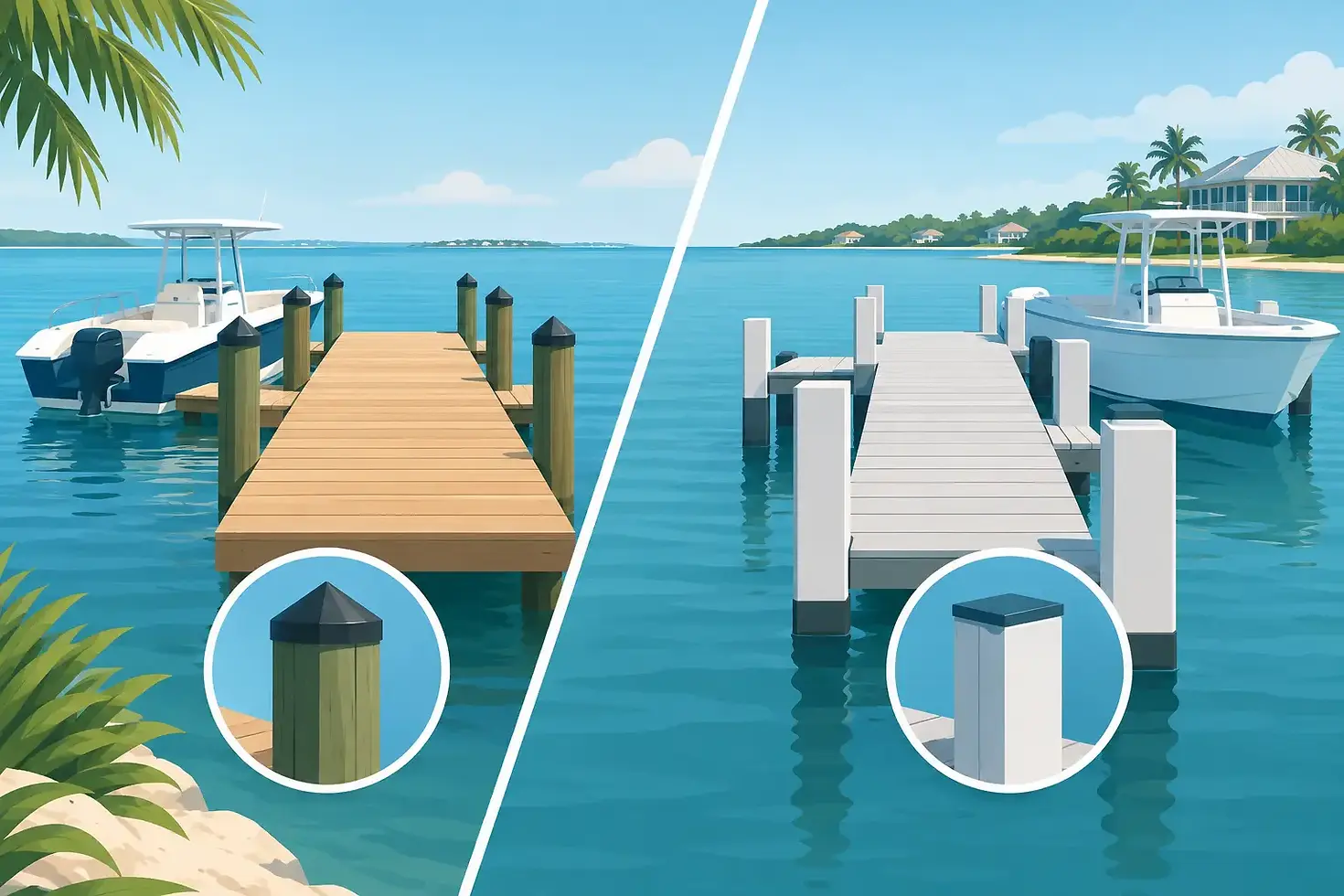
Fixed Dock Comparison for Gulf Coast Properties
A dock should fit the waterway, not just the picture in a brochure. This fixed dock comparison looks at what Gulf Coast property owners need to weigh when choosing between a fixed dock and a floating dock: stability, water depth, storm exposure, access, maintenance, and long-term cost. The right choice depends on your shoreline conditions and how you plan to use the structure year after year.
Fixed Dock Comparison: Fixed vs. Floating
A fixed dock is supported by pilings driven or set into the bottom beneath the water. Its deck stays at a consistent elevation, creating a solid walking surface that feels like an extension of the property. Fixed docks are common on the Gulf Coast because they can be engineered to handle regular use, wide walkways, gathering areas, boat lifts, and accessories such as fish-cleaning stations or power pedestals.
A floating dock rests on buoyant flotation and rises and falls with the water. It is held in place by pilings, guide systems, cables, or other anchoring methods. This can make boarding easier where tides, seasonal water levels, or wake conditions create significant changes between the shoreline and the boat.
Neither structure wins in every setting. A fixed dock offers greater firmness and can be the better platform for a permanent waterfront build. A floating dock can provide better boat access when water levels move frequently. The decision starts with a careful look at the site, not a one-size-fits-all answer.
Stability and daily use
For property owners who want a firm surface underfoot, a fixed dock has a clear advantage. Because its support system is tied to the bottom, it does not move with small waves, passing boat wakes, or people walking across it. That steady feel matters for families, older guests, loading supplies, and marina operations where people are stepping on and off boats throughout the day.
Fixed docks also work well for structures that need dependable support. A covered boat house, fixed pier, elevated deck area, or boat lift requires a properly engineered piling foundation. A floating system may serve as a boarding platform near the boat, but it is not a replacement for a piling-supported structure when the project includes heavier permanent improvements.
Floating docks move by design. In protected water, that movement can be minor and manageable. In exposed areas with frequent wakes or wave action, however, the motion may be more noticeable. The dock’s connection points, flotation, decking, and anchoring system all need regular attention to keep the structure operating safely.
Water depth and boat access
Water depth is one of the biggest deciding factors. A fixed dock deck remains at the same elevation regardless of the water level below it. If the water drops, the distance from deck to boat increases. If the water rises, clearance beneath the dock decreases. This may be acceptable on a stable waterfront with predictable conditions, but it can become inconvenient where tidal changes are substantial.
A floating dock stays close to the boat because it moves with the water. For boaters who regularly board from a low freeboard vessel, this can make access easier. It can also be useful at locations where seasonal water levels shift enough to make a fixed deck uncomfortable or impractical for boarding.
That said, a floating dock still requires adequate water depth. Flotation units can ground during low water, and a dock that sits on the bottom will not perform as intended. A proper site assessment should consider normal water levels, extreme low water, dredging history, bottom conditions, navigation depth, and the draft of the boat you plan to keep there.
What Gulf Coast Conditions Change in a Fixed Dock Comparison
Along coastal Alabama and the Florida Panhandle, saltwater, wind, waves, changing bottoms, and tropical weather all affect dock design. A structure that performs well on a quiet inland lake may not be appropriate for a bay, canal, river, or open-water shoreline near Gulf Shores, Orange Beach, Mobile Bay, Perdido Bay, or Pensacola.
Storm exposure and wave action
A fixed dock is not automatically hurricane-proof simply because it is supported by pilings. Its performance depends on engineering, pile size and embedment, framing connections, deck elevation, lateral bracing, soil conditions, and exposure to surge and waves. In a major storm, water moving beneath and through the structure can be less damaging than water trapped against a solid surface. Design details matter.
Floating docks can rise with changing water levels, which may be beneficial in certain conditions. But they are also subject to forces at their guide piles, hinges, connections, and anchoring systems. Strong wind, surge, wave action, and floating debris can damage a floating dock that was not designed for its environment.
For either type, the goal is not to promise that a dock will never see damage in an extreme storm. The goal is to build the right structure for the site, use quality materials and connections, and plan for the risks that come with Gulf Coast waterfront ownership. Boat lifts, boat houses, seawalls, and nearby structures must also be considered as part of the overall waterfront system.
Bottom conditions and pilings
Fixed docks rely on pilings, so the soil below the water is a major part of the project. Sand, mud, clay, shell, and mixed bottom conditions can affect how piles are installed and how the dock is engineered. The visible deck may look simple, but its long-term performance begins below the waterline.
A floating dock can reduce the amount of fixed structure needed over the water, yet it still needs a dependable anchoring plan. Guide pilings must be properly installed, and shore connections must be built to accommodate movement without creating weak points. A floating dock is not a shortcut around site-specific engineering.
Materials and corrosion resistance
On the Gulf Coast, materials need to stand up to sun, moisture, salt air, and saltwater exposure. Pressure-treated lumber, composite decking, marine-grade hardware, aluminum components, and properly selected flotation all have a place, depending on the project. The best material is not always the most expensive option. It is the one that fits the structure’s use, exposure, maintenance expectations, and budget.
For a fixed dock, attention should go to piling condition, framing, fasteners, cross bracing, decking, handrails, and connections at the shore. For a floating dock, inspect the flotation units, frame, deck panels, hinges, guide systems, and anchoring hardware. Saltwater finds weak connections quickly, especially when maintenance is delayed.
Cost, Maintenance, and Long-Term Value
Initial cost is only one part of the decision. A fixed dock may require more substantial piling and framing work upfront, particularly when the project includes a long pier, covered area, boat lift, or challenging site conditions. However, a well-built fixed dock can provide decades of dependable service when it is maintained properly.
A floating dock may have a lower starting cost for certain layouts, especially where a smaller boarding platform is all that is needed. Costs can rise when the design requires long guide piles, specialized anchoring, heavy-duty flotation, gangways, or wave protection. Replacement of flotation or connection hardware should also be part of the long-term budget.
Maintenance is not optional for either choice. Annual inspections help catch loose hardware, damaged boards, corrosion, pile wear, settling, and storm-related issues before they become larger repairs. After severe weather, inspect the dock promptly, but do not walk on a damaged structure until it has been evaluated for safety.
For commercial properties and marinas, downtime has a real cost. A dependable maintenance plan can help protect slips, walkways, utilities, lifts, and customer access. Residential owners benefit as well, particularly when small repairs can be addressed before they affect the main structure.
Permitting and the Right Project Scope
Waterfront construction often involves permits, setbacks, environmental considerations, navigation requirements, and local regulations. The allowed size, location, height, and configuration of a dock can influence whether a fixed, floating, or combination design makes the most sense.
A common solution is not strictly one or the other. A piling-supported pier may extend from shore to deeper water, with a floating section at the end for easier boat boarding. This combination can provide the stable access of a fixed structure while keeping the boarding surface closer to the boat as water levels change.
Before construction begins, a contractor should understand the intended use of the dock. Will it serve a center-console fishing boat, a pontoon boat, personal watercraft, a lift, a covered slip, or multiple marina tenants? Is the owner prioritizing entertaining space, fishing access, ADA considerations, utility service, or low-maintenance materials? Clear answers lead to a more practical design.
Wide Open Alabama Marine Construction approaches each waterfront project with the conditions of the site and the owner’s goals in mind. Licensed marine construction experience matters when a dock must work with the shoreline, local requirements, boat use, and Gulf Coast weather rather than against them.
A good dock earns its value every time you step onto it with confidence. Start with a site-specific plan, choose the structure that fits your water and your boat, and build it with the same care you expect from the rest of your property.



Comments